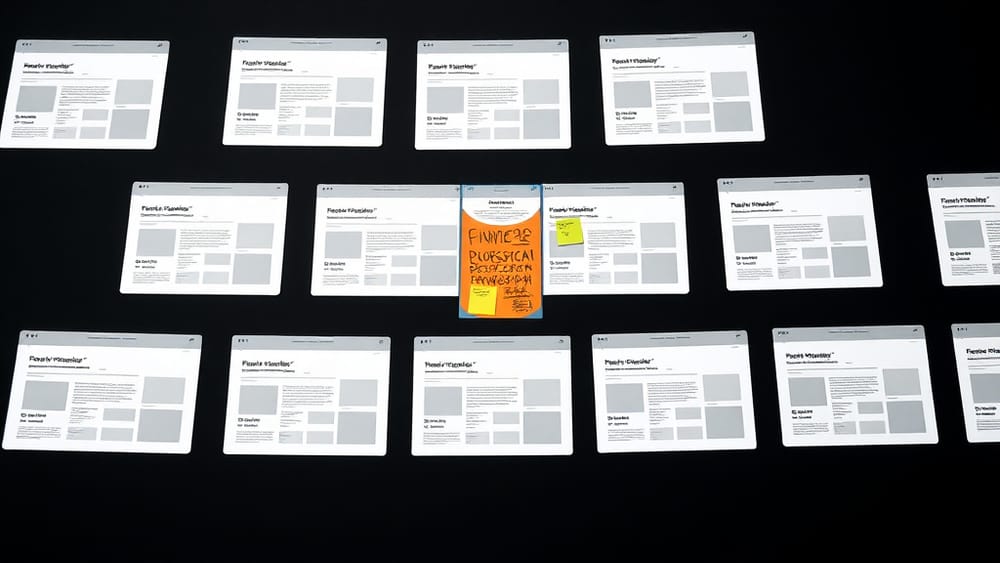
Your portfolio is beautiful. It's also invisible.
Somewhere between 2024 and now, AI crossed a threshold. It stopped producing awkward, obviously-generated layouts and started producing genuinely polished ones. The gradient is right. The type scale is balanced. The case study cards have just enough whitespace. And so does everyone else's portfolio. When every portfolio is beautiful, beautiful stops meaning anything.
This is the trap most developers, designers, and freelancers are walking straight into: optimizing for aesthetics in a world where aesthetics are free.
The Floor Just Became the Ceiling
For years, a well-designed portfolio was a competitive signal. It said: this person cares about craft, has taste, and knows what good looks like. That signal worked because producing a good-looking portfolio required real effort and skill.
Not anymore. AI portfolio generators can produce a professional, attractive site in under ten minutes. The floor of what 'acceptable' looks like has risen dramatically. But here's the problem: so many people are now hitting that floor that it's become the ceiling. You've done the work to look polished, and so has every other candidate in the shortlist.
Generic beauty used to be a baseline. Now it's a red flag. A portfolio that could belong to anyone signals that it belongs to no one in particular.
The Specificity Gap Is Your Real Opportunity
Here's what AI cannot easily generate for you: your actual niche, your specific results, and the honest narrative behind how you work.
These three things, done well, do more for your portfolio than any design trend:
Niche. Not 'full-stack developer' or 'UX designer.' Something tighter and more memorable. 'I build data pipelines for climate tech startups.' 'I design checkout flows that convert for DTC brands.' The narrower the claim, the more credible it feels, and the easier it is for the right client to self-select.
Narrative. Your portfolio should tell a story about how you think, not just what you've shipped. What was the actual problem? What did you try first? What failed? Clients and hiring managers remember the honest version far more than the sanitized highlight reel.
Results data. Numbers are rare in portfolios because most people either don't track them or assume nobody cares. They're wrong on both counts. 'Redesigned the onboarding flow, reduced drop-off by 34%' is worth more than six full-page case study mockups. Even rough data, honestly contextualized, outperforms polished vagueness.
What 'Generic Beauty' Now Communicates
There's a psychological shift happening on the hiring and client side. Recruiters and creative directors who review dozens of portfolios a week are increasingly pattern-matching on what a generic AI-assisted portfolio looks like. Smooth gradients, hero animations, three case study cards with identical layouts, a contact form. They recognize it immediately, and it tells them something specific: this person is optimizing for appearance, not substance.
The irony is sharp. The cleaner and more universally appealing your portfolio looks, the more it can communicate that you have nothing distinctive to say.
Rough edges, opinionated layouts, and unusual content choices now read as signals of genuine taste and confidence. Not sloppy, but specific. A portfolio that feels like it could only belong to you is, in 2026, a stronger signal than one that could belong to anyone in your category.
How to Audit Your Own Portfolio Right Now
Run your portfolio through three quick filters:
- The swap test. Could you paste a competitor's name and projects into your portfolio template without changing anything else? If yes, your structure is too generic.
- The number count. How many specific, quantified results appear in your case studies? If the answer is zero, you have a specificity problem.
- The niche sentence. Can you finish this sentence in one specific line: 'I help [specific type of client] do [specific thing] so they can [specific outcome]'? If it takes a paragraph to answer, your positioning is still blurry.
If you fail all three, the design polish is not your problem. Fixing the content layer will move the needle faster than any visual refresh.
Build Around What AI Can't Replicate
The right response to AI commodifying design is not to try to out-design the machines. It's to double down on what only you can provide: your specific experience, your documented results, and your honest point of view.
The good news is that tools like CV2Folio, built by Novion, are designed to help you extract exactly that from your existing CV or resume and shape it into a portfolio that reflects your actual work, not a generic template. The starting point is your specifics, not a blank canvas trying to look impressive.
The portfolios that will stand out over the next few years won't be the most beautiful ones. They'll be the most specific, the most honest, and the most clearly authored. That's a bar you can clear. It just requires a different kind of effort than most people are currently applying.
Stop competing on polish. Start competing on specificity. Build your portfolio at cv2folio.novion.one.