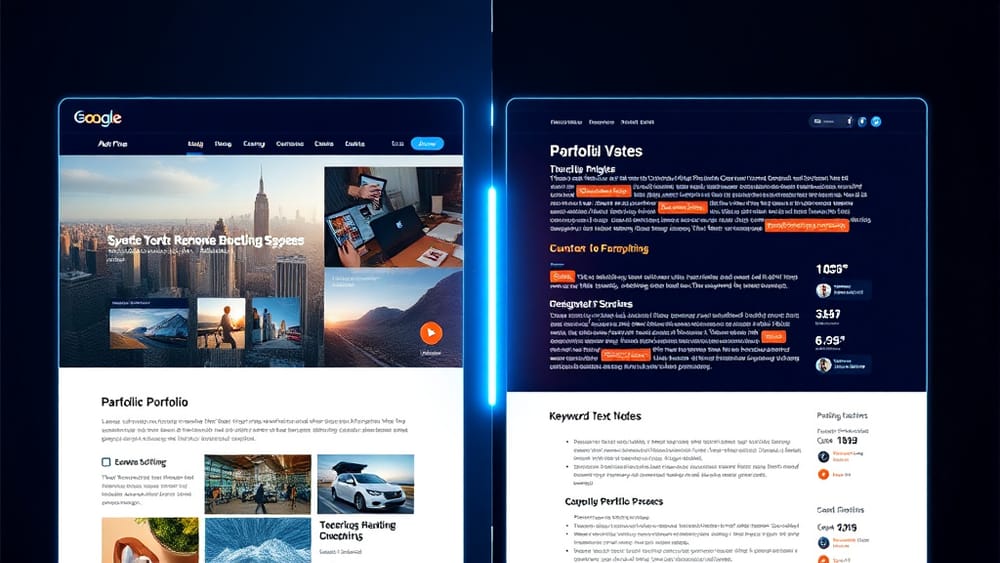
Your portfolio looks great to humans. That's the problem.
In 2026, 78% of recruiters run portfolios through AI pre-screening tools before a single human eye lands on your work. Most of those portfolios are filtered out silently. Not because the work is weak, but because the portfolio was built to impress people, not algorithms. If you don't understand what gets parsed, you don't get seen.
Here is exactly what the scoring systems are looking for, and what most developers, designers, and freelancers get wrong.
The Algorithm Doesn't See Your Visuals
This is the hardest truth to accept if you've spent hours perfecting your layout. AI screening tools parse text, structured data, and metadata. They extract keywords, quantified outcomes, role-relevant terminology, and signals of seniority. Your beautiful case study hero image? Invisible. Your custom font pairing? Not parsed. Your animated project cards? Ignored entirely.
What the algorithm does see: your project descriptions, your job title history, the specific technologies you name, and whether your outcomes are expressed as measurable results or vague claims. "Redesigned the checkout flow" scores lower than "Redesigned the checkout flow and reduced cart abandonment by 22%."
The gap between how most portfolios are written and what AI systems reward is enormous. And almost nobody is closing it.
What the Scoring Rubric Actually Rewards
While every recruiter-side AI tool has its own weighting, the scoring patterns that emerge across platforms like HireVue, Findem, and Paradox share consistent signals:
1. Keyword density and specificity. Not stuffed keywords, but the precise technical language that matches the role's requirements. If a job description says "React," your portfolio needs to say "React," not just "JavaScript frameworks." Generic terms are scored lower than exact matches.
2. Impact quantification. Numbers beat adjectives, every time. Algorithms are trained to extract measurable outcomes. Revenue impact, performance improvements, user growth, time saved: these get flagged as positive signals. "Improved performance" gets deprioritized against "cut load time from 4.2 seconds to 1.1 seconds."
3. Recency weighting. Projects from the last 24 months carry more scoring weight. Older work that isn't contextualized with current relevance often drags your aggregate score down.
4. Role-signal clarity. The algorithm tries to classify you. If your portfolio mixes too many disciplines without a clear primary role, the classifier hedges and your relevance score drops for any specific role. A full-stack developer who also does branding work needs to lead with the identity that matches the application.
5. Semantic coherence. Modern AI screening tools use embedding-based matching, not just keyword lookup. They check whether the overall semantic profile of your portfolio aligns with the role. This means the framing of your work matters as much as the individual words.
The Three Mistakes That Get Portfolios Filtered Out
Optimizing only for the visual layer. A stunning portfolio site with thin or vague project descriptions is a common failure mode for designers especially. The copy in your case studies does the algorithmic heavy lifting. Invest in it.
Writing in past tense without outcomes. "Built a mobile app for a healthcare client" is a dead-end sentence for an AI parser. It contains a verb, a noun, and a category. It signals nothing about impact, scale, or outcome. Rewrite every project description to include: what you built, the problem it solved, and a concrete result.
Ignoring the text behind the visuals. Alt text, project metadata, page titles, and even file names contribute to how AI tools index your site. If your case study images have no alt text, you're leaving structured data on the table. If your project page titles are "Project 01" and "Project 02," you're actively hurting your discoverability.
How to Rewrite Your Portfolio for Algorithmic Visibility
Start with your project descriptions. For each project, write one sentence that follows this structure: [Role verb] + [specific technology or method] + [measurable outcome or context]. Then expand from there.
Audit your keyword coverage. Pull three to five job descriptions from roles you actually want. Identify the 10 most-repeated technical terms. Check whether those terms appear naturally in your portfolio copy. If they don't, add them in context.
Add numbers wherever you can find them. Look back at your project history for any metric that was tracked: conversion rates, performance benchmarks, team size, timeline compression, client retention. Even approximate numbers are better than none.
Organize your portfolio around a clear role identity. If you're a product designer who codes, lead with design and frame the engineering as a supporting capability. If you're a full-stack developer with some UX sensibility, lead with engineering. Pick the lane that matches your target roles and structure everything around it.
Finally, make sure your portfolio is indexable. Use semantic HTML, add descriptive alt text to every project image, write descriptive page titles, and ensure your project descriptions are in crawlable text, not embedded in images or canvas elements.
The Human Review Still Matters, But Only If You Pass the Filter
None of this means visual quality stops mattering. Once your portfolio clears the algorithmic layer, a human recruiter or hiring manager reviews it. At that point, your layout, your case study depth, and your presentation absolutely influence the decision. The visual layer earns you the offer. The algorithmic layer earns you the review.
The portfolios that succeed in 2026 are built with both audiences in mind: structured, keyword-coherent, and outcome-rich for the AI, and clear, compelling, and visually confident for the human who comes after.
Tools like CV2Folio, built by Novion, are designed with exactly this dual-layer problem in mind. When you build your portfolio from your CV or resume, the structure and language of your professional history are preserved in a way that maps cleanly to what algorithmic screeners parse, while still producing a portfolio site that looks polished to the human reviewers who matter most.
Stop building portfolios that only humans can appreciate. The first audience is a machine, and it doesn't care how good your gradients look.
Build your portfolio at CV2Folio and start with a structure that's built to pass both filters.