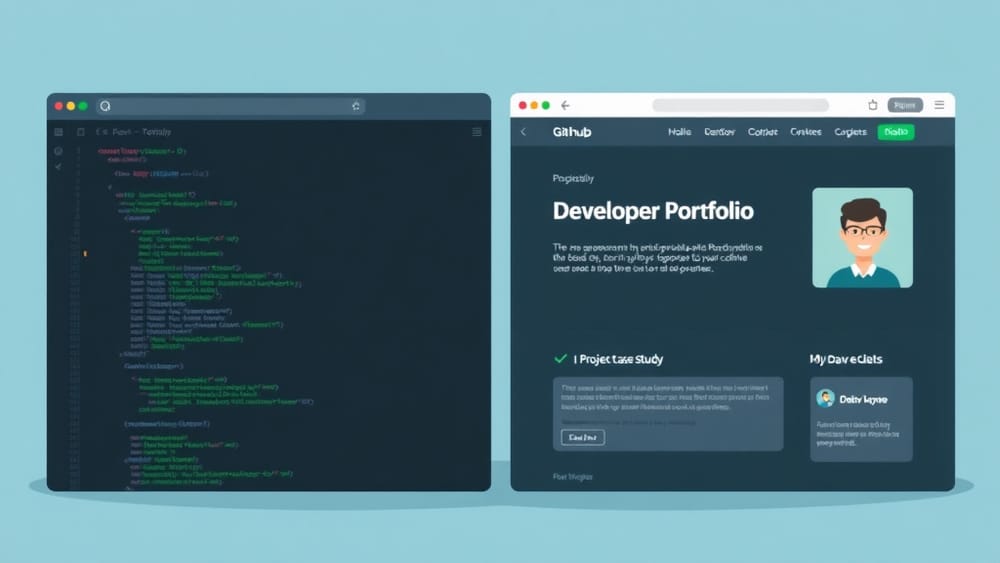
You write cleaner code than half the candidates who beat you to an offer. So why are you still waiting to hear back?
The answer is almost never your code. It is how you presented it.
In 2026, the average time-to-hire sits at 68 days. That is 68 days of your repo sitting unread in a hiring manager's browser tab while a candidate with a readable, human-first portfolio has already moved to the final round. GitHub is a tool for engineers. A portfolio is a tool for getting hired. They are not the same thing.
What Hiring Managers Actually See When They Open Your GitHub
Let's be honest about who reviews your application before it reaches a technical interviewer. In most companies, that is an HR coordinator, a recruiter, or a non-technical hiring manager. They are not going to clone your repo. They are not going to read your README. They are scanning for signal in under 90 seconds.
What they see on GitHub:
- A list of repository names
- Commit graphs that look like noise
- Files named
utils.jsand folders namedsrc - A README that starts with "Installation"
None of that tells them whether you can solve their problem. None of it tells them what you built, why it mattered, or what happened because you built it.
GitHub Shows What You Built. A Portfolio Shows How You Think.
This is the core distinction. A GitHub repo is evidence of output. A portfolio is a narrative of impact.
Consider the difference between these two descriptions of the same project:
GitHub README: "A Node.js REST API with JWT authentication and PostgreSQL integration."
Portfolio case study: "Built a backend API that cut our team's data retrieval time by 40%, unblocking a three-week product bottleneck. Used Node.js and PostgreSQL, with JWT authentication to meet the client's security compliance requirements."
The first describes a stack. The second describes a developer who understands business context, communicates clearly, and delivers results. The second candidate gets the call.
Technical interviewers care about your code. Everyone else in the hiring chain cares about what your code did for the business. A portfolio bridges that gap. A GitHub profile does not.
The 2026 Job Market Does Not Reward Quiet Competence
The market is recovering, but it is still brutally competitive in most engineering tracks. Companies are running leaner hiring teams and faster filtering pipelines. If your application does not immediately communicate value, it gets filtered out before a human ever makes a judgment call.
Quiet competence does not survive automated screening. A well-structured portfolio with clear project descriptions, measurable outcomes, and a coherent professional narrative is not a nice-to-have. It is the minimum bar for being taken seriously by anyone outside of engineering.
Freelancers face an even steeper version of this problem. A client hiring a freelance developer has zero context for evaluating code quality. They are evaluating trust. A portfolio builds trust. A GitHub link builds confusion.
What a Human-First Portfolio Actually Looks Like
A portfolio that works for non-technical stakeholders does not dumb things down. It translates. There is a difference.
Here is what to include for each featured project:
- The problem in plain language. What was broken, slow, or missing before you got involved?
- Your specific role. Not the team's work. Your decisions, your implementation, your ownership.
- The outcome in measurable terms. Time saved, revenue impacted, users served, reliability improved.
- The technical layer, briefly. One or two sentences on stack and approach, enough for a technical reader to respect the work without overwhelming a non-technical one.
- A visual or demo link. Screenshots, a live URL, or a short video. Something a person can see without reading code.
You do not need twenty projects. Three strong case studies beat a wall of repos every time.
Your GitHub Is Evidence. Your Portfolio Is Your Argument.
Keep your GitHub active. Contribute to open source. Maintain clean commit histories. None of that advice is wrong.
But stop treating your GitHub profile as a substitute for a portfolio. It is not. It is a supporting document, the same way transcripts support a resume. Nobody hires based on transcripts alone.
The developers who are shortening that 68-day hiring cycle are the ones who make it easy for every person in the hiring chain, technical or not, to understand why they are the right choice. They do that with a portfolio, not a link to their repos.
CV2Folio is built for exactly this: turning the work history you already have into a portfolio that communicates value to engineers and non-engineers alike. It is built by Novion and takes your existing CV as the starting point, so you are not building from scratch.
Stop letting better-presented candidates beat you to offers you deserve. Build your portfolio at cv2folio.novion.one.