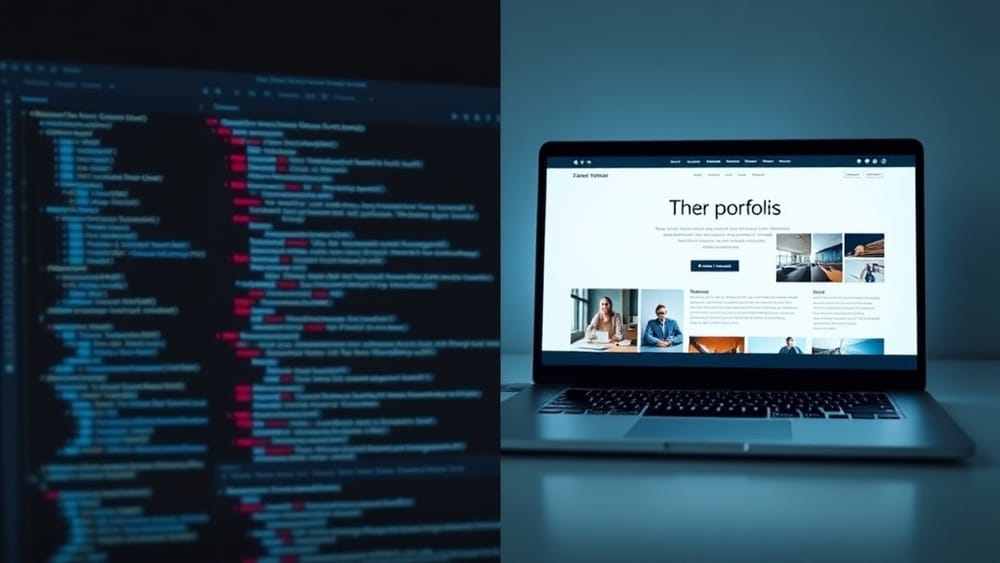
Your hand-coded portfolio took three weekends to build. An AI tool can beat it in 60 seconds. That should make you uncomfortable.
For years, the developer community treated building your own portfolio from scratch as a rite of passage. Pick a framework, wrestle with CSS, agonize over color palettes, deploy to Netlify, repeat. Designers spent hours in Figma before writing a single line of code. Freelancers cobbled together Squarespace pages that looked like everyone else's.
That era is over. AI portfolio generators have crossed a quality threshold where hand-coded sites no longer have a meaningful advantage for job search outcomes. Here is what is actually happening, and what you are missing if you are still doing it the old way.
The 'Build From Scratch' Mentality Has a Hidden Cost
Building your own portfolio is not free. It costs time, and time is the one thing job seekers and freelancers have the least of.
A realistic breakdown of a DIY portfolio build:
- Framework setup and tooling: 2-4 hours
- Design decisions (layout, typography, color): 4-8 hours across multiple sessions
- Writing and editing copy: 3-5 hours
- Responsive CSS and cross-browser fixes: 2-6 hours
- Deployment and domain setup: 1-2 hours
- Ongoing maintenance: ongoing, indefinitely
Conservatively, you are looking at 12 to 25 hours before a recruiter sees your work. And that is assuming you already know what you are doing. Junior developers and career-changers often spend far longer, and still ship something they are not proud of.
The hidden cost is not just time. It is the opportunity cost of not applying to roles, not updating your case studies, not networking, while you are tweaking your navbar animation.
What AI Portfolio Generators Actually Do Well
The criticism of AI tools used to be fair: they produced generic, cookie-cutter output that screamed "template." That gap has closed significantly.
Modern AI portfolio generators do several things well that humans consistently get wrong:
They extract structure from your existing CV. Instead of staring at a blank page, you upload what you already have. The AI identifies your roles, skills, projects, and achievements and maps them into a portfolio structure that makes sense for your field.
They write better copy than most people write about themselves. Self-promotion is awkward. Most developers describe their projects with bullet points like "built a REST API." AI tools reframe those bullets into outcome-driven narratives that recruiters and clients actually respond to.
They make design decisions fast. Typography pairing, spacing, contrast ratios, responsive breakpoints. These are solved problems that AI handles in seconds. You spend your time reviewing, not deciding.
They ship something real. The biggest advantage is not quality. It is that you end up with a live, shareable URL before you have time to talk yourself out of it.
CV2Folio, built by Novion, is built around exactly this workflow. Upload your CV, get a polished portfolio site, done. No framework decisions, no CSS debates, no three-weekend commitment.
Hand-Coded vs. AI-Generated: What the Outcome Data Suggests
Let's be direct about what actually matters in a portfolio: does it get you hired or does it get you clients?
A few things that research and hiring manager interviews consistently surface:
- Load speed matters more than custom animations. Recruiters open dozens of portfolios in a session. A slow site gets closed. AI-generated sites on modern infrastructure are typically faster than custom builds on shared hosting.
- Content clarity beats visual novelty. Hiring managers want to find your best work in under 30 seconds. AI tools optimize for that information hierarchy. Custom builds often prioritize aesthetic ambition over usability.
- A live site beats a perfect site. The portfolio that exists wins over the portfolio that is still being built. Every time.
This does not mean hand-coded portfolios are worthless. If you are applying for a senior frontend role and your portfolio itself demonstrates your frontend skills, a custom build is part of the pitch. But that is a specific case, not a universal rule.
For the majority of developers, designers, and freelancers, the job is not to build a portfolio. The job is to get work. The portfolio is a means to that end.
Tools Worth Knowing in 2025
The AI portfolio space is growing fast. A few tools worth comparing:
CV2Folio is purpose-built for professionals who want to go from CV to live portfolio site without friction. It handles parsing, copywriting, design, and deployment in a single flow. Strong choice if speed and polish are the priority.
Butternut AI takes a broader website builder approach, letting you generate entire sites from a text prompt. More flexible but requires more input to get portfolio-specific results. Worth trying if you want more control over the site structure beyond a standard portfolio format.
Read.cv is worth mentioning as a simpler alternative: a community-focused profile tool that is not strictly AI-generated but removes most of the setup friction. Good for designers who want a clean, minimal presence fast.
The right tool depends on your use case. But the common thread is speed and reduction of decision fatigue. That is the actual product being sold, and it is worth paying for.
The Real Reason Developers Still Build From Scratch
Here is the honest answer: building your own portfolio feels like productive work. It scratches the same itch as a side project. You are writing code, making decisions, solving problems. It feels like progress.
But if your goal is to get a job or land a client, shipping a portfolio that exists in the world today beats shipping a perfect one in three weeks. Every time.
The developers and designers who are moving fastest right now are the ones who separated "building things I want to build" from "getting the infrastructure in place to get hired." AI tools handle the second category. That frees you up to focus on the first.
If you have been putting off your portfolio because it feels like a big project, it is not anymore. Build your portfolio at cv2folio.novion.one.