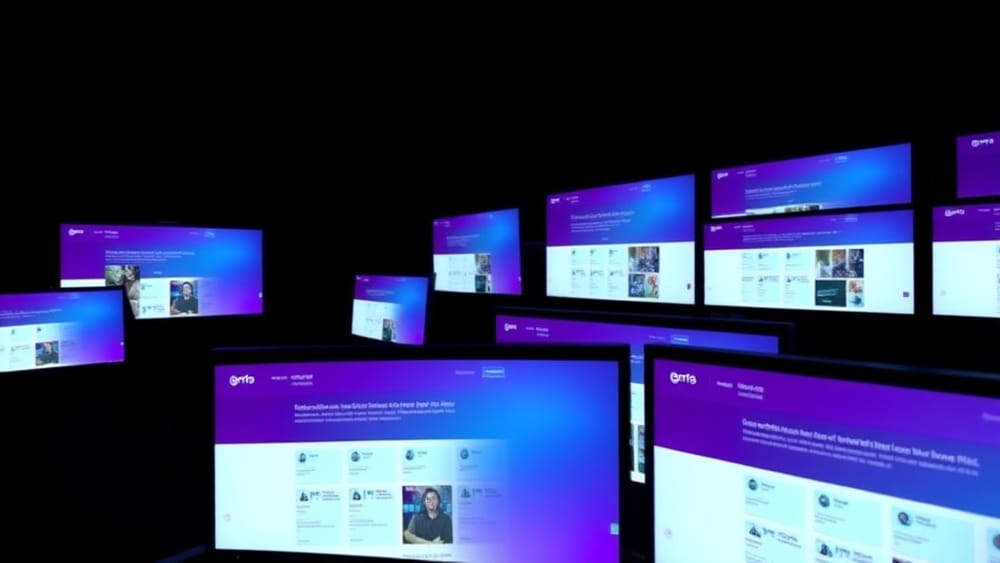
Your AI-generated portfolio looks exactly like everyone else's. That's the problem nobody is talking about.
In 2026, the barrier to building a portfolio dropped to nearly zero. Paste your CV, pick a template, deploy. Done in under ten minutes. The result? A sea of bento grids, dark gradients, glassmorphism cards, and copy that reads like it was written by the same intern at every company. Technically impressive. Completely forgettable.
This is the AI portfolio paradox: the tools designed to help you stand out are the reason you blend in.
Every AI Builder Is Trained on the Same Aesthetic Playbook
Here's what's actually happening under the hood. Most AI portfolio generators are trained on the same corpus of highly-upvoted Dribbble shots, trending GitHub Pages themes, and award-winning personal sites from 2022 to 2024. The model learned what "looks good" from a very specific slice of the internet, and it replicates that aesthetic confidently and relentlessly.
The output is predictable: a hero section with a short punchy headline, a skills grid with floating icons, a project section in a masonry or bento layout, a dark mode by default, and a gradient that runs from purple to cyan. Sound familiar? It should. You've seen it on forty portfolios this week.
The AI isn't being lazy. It's being accurate. It's giving you the statistically most-approved design. That's exactly the problem.
Speed Is the Right Reason to Use AI. Design Is Not.
This is the contrarian take worth sitting with: AI portfolio tools are genuinely useful, just not for the reasons most people use them.
The real value is speed. Parsing your CV, scaffolding your project structure, generating a first draft of your bio, setting up deployment, handling responsive layout. These are tedious, low-leverage tasks that AI handles well. Getting from blank page to functional site in under an hour is a legitimate competitive advantage, because it frees up time for the thing AI cannot do for you.
It cannot tell your story. It cannot explain why you left a stable job to build something weird and niche. It cannot articulate the specific frustration that made you redesign a dashboard from scratch at 11pm on a Tuesday. It cannot communicate your actual point of view on your craft.
That's the work. And most people skip it because the AI-generated placeholder copy feels good enough.
What "Unique Positioning" Actually Looks Like in Practice
Vague advice like "show your personality" is useless. Here's what actually differentiates a portfolio in 2026:
A specific claim, not a category. Instead of "Full-stack developer with 5 years of experience," try "I build internal tools that ops teams actually want to use." The first is a credential. The second is a positioning statement that signals taste, context, and a clear type of client or employer.
Case studies with friction. Document the moment a project almost failed. What broke, what you tried, what worked. Generic portfolios show polished outcomes. Memorable portfolios show honest process. Hiring managers and clients have been lied to by portfolios enough times that they're actively looking for signals of real thinking.
A voice that scans as human. Read your bio out loud. If it sounds like a LinkedIn summary written by a committee, rewrite it. One sentence that's slightly weird or specific to you is worth more than three paragraphs of professional-sounding nothing.
Selective work, not comprehensive work. Showing twelve projects signals insecurity. Showing four exceptional ones with real depth signals judgment. Judgment is one of the hardest things to demonstrate and one of the most valuable things a portfolio can communicate.
The Workflow That Actually Works
Use AI to build fast. Then use the time you saved to go deep on positioning.
Concretely: let the AI scaffold your site, generate your initial copy, and handle the structural layout. Then block two hours and do this manually:
- Rewrite your headline from scratch, without AI assistance. Write ten versions. Pick the one that makes you slightly uncomfortable because it's too specific.
- Pick your two or three best projects and write a genuine case study for each. Aim for 300 to 500 words that include a real constraint, a real decision, and a real outcome with a number attached.
- Delete the skills grid with the floating icons. Replace it with a short paragraph about how you actually work and what you care about.
- Read the whole site as if you've never met yourself. Ask: would I reach out to this person? If the answer is "probably," you're not done yet.
Tools like CV2Folio, built by Novion, are designed to handle exactly this trade-off: fast scaffolding from your existing CV so you're not starting from scratch, with enough flexibility to make the result genuinely yours rather than another gradient clone. The speed is the feature. What you do with that speed is the differentiator.
The Aesthetic Monoculture Will Correct Itself. Be Early.
Design trends always invert. The bento grid moment will pass. Dark gradients will start to read as dated. The portfolios that age well are the ones that were never chasing the trend in the first place, because they were built around a clear point of view rather than a prevailing aesthetic.
The irony is that the fastest path to a distinctive portfolio in 2026 is to use AI aggressively for everything structural, then spend that recovered time doing the slow, specific, human work of figuring out what you actually want to say and saying it clearly.
That combination is genuinely rare. Which means it's genuinely valuable.
Build your portfolio at cv2folio.novion.one and use the time you save to make it actually yours.